An Easy Method of Identifying the Trees of Glacier National Park
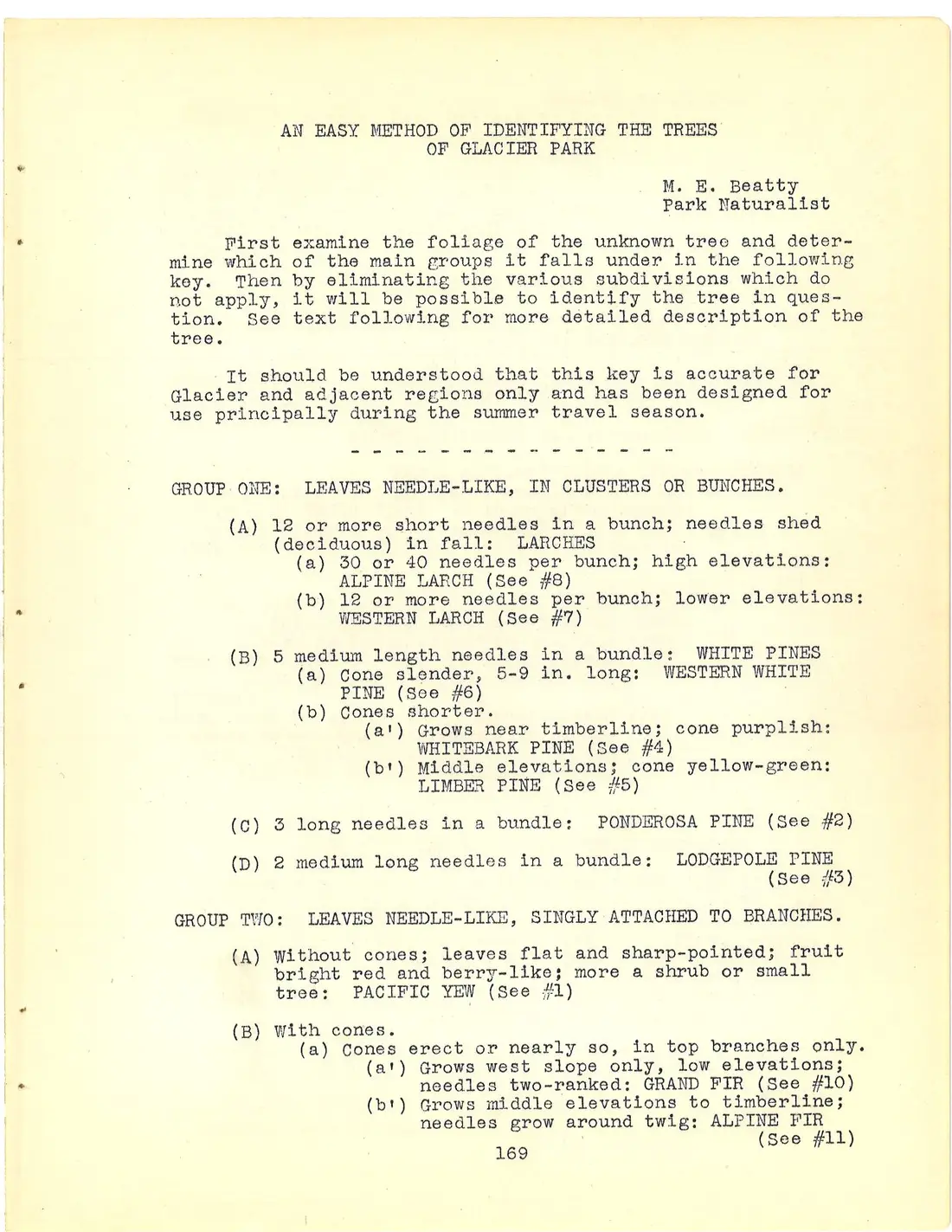
AN EASY METHOD OF IDENTIFYING THE TREES OF GLACIER PARK
M. E. Beatty Park Naturalist
First examine the foliage of the unknown tree and determine which of the main groups it falls under in the following key. Then by eliminating the various subdivisions which do not apply, it will be possible to identify the tree in question. See text following for more detailed description of the tree.
It should be understood that this key is accurate for Glacier and adjacent regions only and has been designed for use principally during the summer travel season.
GROUP ONE: LEAVES NEEDLE-LIKE, IN CLUSTERS OR BUNCHES.
(A) 12 or more short needles in a bunch; needles shed (deciduous) in fall: LARCHES
(a) 30 or 40 needles per bunch; high elevations: ALPINE LARCH (See #8)
(b) 12 or more needles per bunch; lower elevations: WESTERN LARCH (See #7)
(B) 5 medium length needles in a bundle: WHITE PINES
(a) Cone slender, 5-9 in. long: WESTERN WHITE PINE (See #6)
(b) Cones shorter.
(a') Grows near timberline; cone purplish: WHITEBARK PINE (See #4)
(b') Middle elevations; cone yellow-green: LIMBER PINE (See #5)
(C) 3 long needles in a bundle: PONDEROSA PINE (See #2)
(D) 2 medium long needles in a bundle: LODGEPOLE PINE (See #3)
GROUP TWO: LEAVES NEEDLE-LIKE, SINGLY ATTACHED TO BRANCHES.
(A) Without cones; leaves flat and sharp-pointed; fruit bright red and berry-like; more a shrub or small tree: PACIFIC YEW (See #1)
(B) With cones.
(a) Cones erect or nearly so, in top branches only.
(a') Grows west slope only, low elevations; needles two-ranked: GRAND FIR (See #10)
(b') Grows middle elevations to timberline; needles grow around twig: ALPINE FIR (See #11)
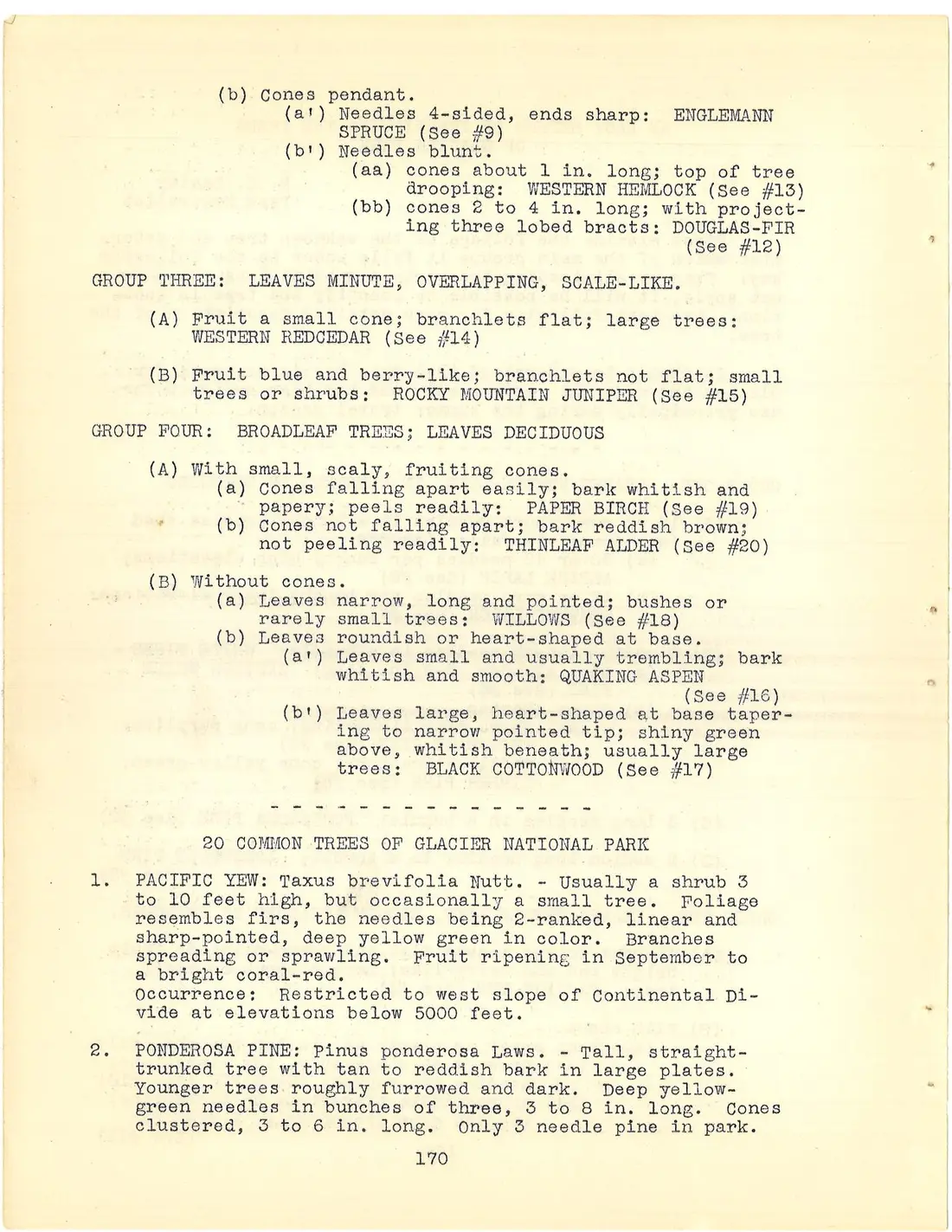
(b) Cones pendant.
(a') Needles 4-sided, ends sharp: ENGLEMANN SPRUCE (See #9)
(b') Needles blunt.
(aa) cones about 1 in. long; top of tree drooping: WESTERN HEMLOCK (See #13)
(bb) cones 2 to 4 in. long; with projecting three lobed bracts: DOUGLAS-FIR (See #12)
GROUP THREE: LEAVES MINUTE, OVERLAPPING, SCALE-LIKE.
(A) Fruit a small cone; branchlets flat; large trees: WESTERN REDCEDAR (See #14)
(B) Fruit blue and berry-like; branchlets not flat; small trees or shrubs: ROCKY MOUNTAIN JUNIPER (See #15)
GROUP FOUR: BROADLEAF TREES; LEAVES DECIDUOUS
(A) With small, scaly, fruiting cones.
(a) Cones falling apart easily; bark whitish and papery; peels readily: PAPER BIRCH (See #19)
(b) Cones not falling apart; bark reddish brown; not peeling readily: THINLEAF ALDER (See #20)
(B) Without cones.
(a) Leaves narrow, long and pointed; bushes or rarely small trees: WILLOWS (See #18)
(b) Leaves roundish or heart-shaped at base.
(a') Leaves small and usually trembling; bark whitish and smooth: QUAKING ASPEN (See #16)
(b') Leaves large, heart-shaped at base tapering to narrow pointed tip; shiny green above, whitish beneath; usually large trees: BLACK COTTONWOOD (See #17)
20 COMMON TREES OF GLACIER NATIONAL PARK
1. PACIFIC YEW: Taxus brevifolia Nutt. - Usually a shrub 3 to 10 feet high, but occasionally a small tree. Foliage resembles firs, the needles being 2-ranked, linear and sharp-pointed, deep yellow green in color. Branches spreading or sprawling. Fruit ripening in September to a bright coral-red. Occurrence: Restricted to west slope of Continental Divide at elevations below 5000 feet.
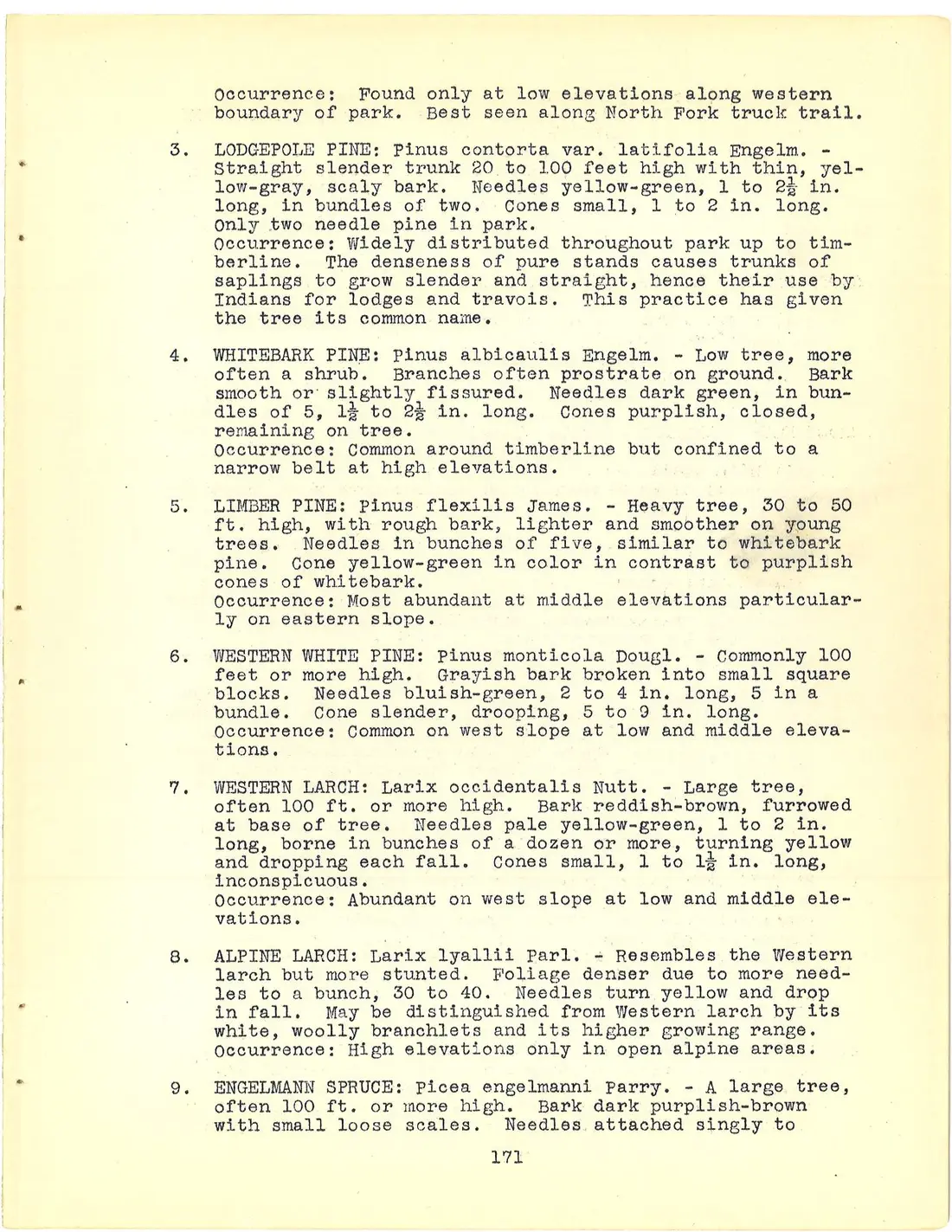
2. PONDEROSA PINE: Pinus ponderosa Laws. - Tall, straight-trunked tree with tan to reddish bark in large plates. Younger trees roughly furrowed and dark. Deep yellow-green needles in bunches of three, 3 to 8 in. long. Cones clustered, 3 to 6 in. long. Only 3 needle pine in park. Occurrence: Found only at low elevations along western boundary of park. Best seen along North Fork truck trail.
3. LODGEPOLE PINE: Pinus contorta var. latifolia Engelm. - Straight slender trunk 20 to 100 feet high with thin, yellow-gray, scaly bark. Needles yellow-green, 1 to 2½ in. long, in bundles of two. Cones small, 1 to 2 in. long. Only two needle pine in park. Occurrence: Widely distributed throughout park up to timberline. The denseness of pure stands causes trunks of saplings to grow slender and straight, hence their use by Indians for lodges and travois. This practice has given the tree its common name.
4. WHITEBARK PINE: Pinus albicaulis Engelm. - Low tree, more often a shrub. Branches often prostrate on ground. Bark smooth or slightly fissured. Needles dark green, in bundles of 5, 1½ to 2½ in. long. Cones purplish, closed, remaining on tree. Occurrence: Common around timberline but confined to a narrow belt at high elevations.
5. LIMBER PINE: Pinus flexilis James. - Heavy tree, 30 to 50 ft. high, with rough bark, lighter and smoother on young trees. Needles in bunches of five, similar to whitebark pine. Cone yellow-green in color in contrast to purplish cones of whitebark. Occurrence: Most abundant at middle elevations particularly on eastern slope.
6. WESTERN WHITE PINE: Pinus monticola Dougl. - Commonly 100 feet or more high. Grayish bark broken into small square blocks. Needles bluish-green, 2 to 4 in. long, 5 in a bundle. Cone slender, drooping, 5 to 9 in. long. Occurrence: Common on west slope at low and middle elevations.
7. WESTERN LARCH: Larix occidentalis Nutt. - Large tree, often 100 ft. or more high. Bark reddish-brown, furrowed at base of tree. Needles pale yellow-green, 1 to 2 in. long, borne in bunches of a dozen or more, turning yellow and dropping each fall. Cones small, 1 to 1½ in. long, inconspicuous. Occurrence: Abundant on west slope at low and middle elevations.
8. ALPINE LARCH: Larix lyallii Parl. - Resembles the Western larch but more stunted. Foliage denser due to more needles to a bunch, 30 to 40. Needles turn yellow and drop in fall. May be distinguished from Western larch by its white, woolly branchlets and its higher growing range. Occurrence: High elevations only in open alpine areas.
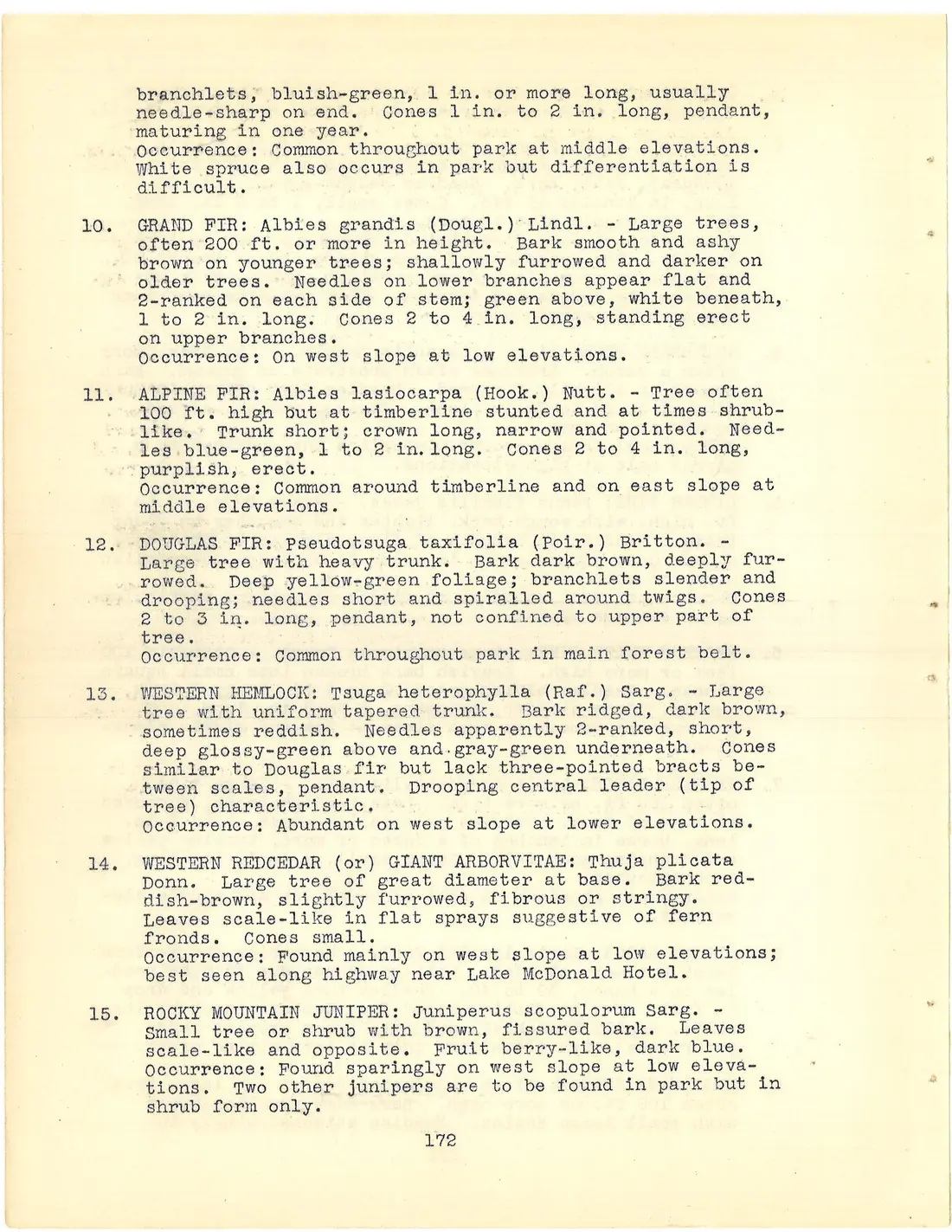
9. ENGELMANN SPRUCE: Picea engelmanni Parry. - A large tree, often 100 ft. or more high. Bark dark purplish-brown with small loose scales. Needles attached singly to branchlets, bluish-green, 1 in. or more long, usually needle-sharp on end. Cones 1 in. to 2 in. long, pendant, maturing in one year. Occurrence: Common throughout park at middle elevations. White spruce also occurs in park but differentiation is difficult.
10. GRAND FIR: Albies grandis (Dougl.) Lindl. - Large trees, often 200 ft. or more in height. Bark smooth and ashy brown on younger trees; shallowly furrowed and darker on older trees. Needles on lower branches appear flat and 2-ranked on each side of stem; green above, white beneath, 1 to 2 in. long. Cones 2 to 4 in. long, standing erect on upper branches. Occurrence: On west slope at low elevations.
11. ALPINE FIR: Albies lasiocarpa (Hook.) Nutt. - Tree often 100 ft. high but at timberline stunted and at times shrub-like. Trunk short; crown long, narrow and pointed. Needles blue-green, 1 to 2 in. long. Cones 2 to 4 in. long, purplish, erect. Occurrence: Common around timberline and on east slope at middle elevations.
12. DOUGLAS FIR: Pseudotsuga taxifolia (Poir.) Britton. - Large tree with heavy trunk. Bark dark brown, deeply furrowed. Deep yellow-green foliage; branchlets slender and drooping; needles short and spiralled around twigs. Cones 2 to 3 in. long, pendant, not confined to upper part of tree. Occurrence: Common throughout park in main forest belt.
13. WESTERN HEMLOCK: Tsuga heterophylla (Raf.) Sarg. - Large tree with uniform tapered trunk. Bark ridged, dark brown, sometimes reddish. Needles apparently 2-ranked, short, deep glossy-green above and gray-green underneath. Cones similar to Douglas fir but lack three-pointed bracts between scales, pendant. Drooping central leader (tip of tree) characteristic. Occurrence: Abundant on west slope at lower elevations.
14. WESTERN REDCEDAR (or) GIANT ARBORVITAE: Thuja plicata Donn. Large tree of great diameter at base. Bark reddish-brown, slightly furrowed, fibrous or stringy. Leaves scale-like in flat sprays suggestive of fern fronds. Cones small. Occurrence: Found mainly on west slope at low elevations; best seen along highway near Lake McDonald Hotel.
15. ROCKY MOUNTAIN JUNIPER: Juniperus scopulorum Sarg. - Small tree or shrub with brown, fissured bark. Leaves scale-like and opposite. Fruit berry-like, dark blue. Occurrence: Found sparingly on west slope at low elevations. Two other junipers are to be found in park but in shrub form only.
16. GOLDEN ASPEN: Populus tremuloides aurea (Tide.) Dan. Small, slender tree with greenish-white, smooth bark. Leaves pale green, rounded, 1 to 2 inches long, finely toothed, turning yellow and gold in autumn before dropping. Leaves constantly quivering in slightest breeze. Occurrence: Common at lower altitudes in park.
17. BALSAM POPLAR: Populus tacamahacca Mill. - Small to large trees. Bark on young trees similar to golden aspen but darken and become deeply furrowed with age. Leaves 2 to 5 inches long, heart-shaped at base tapering to a slender tip, finely toothed shiny deep green above, whitish beneath, turning yellow in autumn before dropping. Occurrence: Common at low elevations throughout park, particularly along water courses.
18. WILLOWS: Salix Sp. - Some 25 forms of willows are listed for the park but most of these are shrub or dwarf forms. The Scouler willow (Salis sceuleriana) and the peachleaf willow (Salix amygdaloides) reach tree size and are found at low and middle elevations. Leaves are usually narrow and alternate.
19. NORTHWESTERN PAPER BIRCH: Betula papyrifera subcordata (Rydb.) Sarg. - Moderate sized trees with white, papery bark which peels off readily. Leaves roundish with pointed tips, irregularly toothed, 1½ to 3 inches long. Occurrence: Common on west slope at low and middle elevations. Large specimens visible along shore of Lake McDonald. Several other birches occur in park but they are either shrub or small trees.
20. THINLEAF ALDER: Alnus tenuifolia Nutt. - Small tree or shrub, 3 to 16 feet high with smoother, reddish-brown bark. Leaves oval or ovate, 1½ to 4 inches long, thick, dull green. Cones tiny. Occurrence: Common at low altitudes along streams or in wet places. The Sitka alder also occurs in shrub form, forming thick mats, but at higher elevations.