The Mountain Goat of Glacier National Park
THE MOUNTAIN GOAT OF GLACIER NATIONAL PARK
L. Floyd Keller Park Ranger
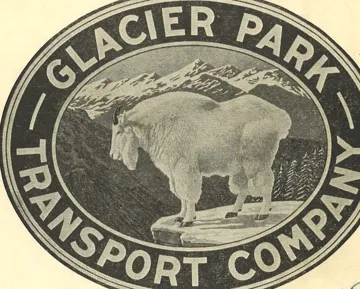
The mountain goat is the most distinctly representative animal of Glacier National Park, an imperturbable, daring ungulate; a mountaineer possessing unexcelled qualities for Alpine climbing. His love of the high places, his surefootedness and superb equanimity while scaling the steepest precipice and the most formidable mountain are challenges very grave to whomever might follow in his footsteps. Only one other national park, Mount Rainier, can boast of its presence. This eccentric animal is the symbol of the Glacier Park Transport Company and other park operators. It is appropriately portrayed with the Great Northern Railway, the story of which is so closely interwoven with the history of the park.
"The....Rocky Mountain goat is really one of a small group of mountain-frequenting antelopes of which the European chamois is a member."--H. E. Anthony. "He is the only American representative of the numerous species of wild goats, ibexes and other goat-like animals so numerous throughout the Old World from Japan to India, southern Europe and northern Africa."--W. T. Hornaday. "Its nearest relatives are the Forest-goats or Goat-antelopes of Asia--namely, the Serow of Japan, and the Goral of the Himalayas; also the chamois of the European mountains. All of these, including our goat, are placed in the Subfamily Rupicaprinae."--E. T. Seton. There are four races of mountain goats in America. The domesticated goat is a distant relative.
Mountain goats are found in the rugged region of northwestern United States and western Canada from the Bitter Roots of Montana, the Salmon River Mountains of Idaho, and the Cascades of Washington to the Rockies of the Yukon Territory. Seton indicates that their distribution extends to the Coast Range and the Selkirks, with about one quarter of the total area utilized located in the Rocky Mountains. Cragginess of topography and water supply appear to be two indispensable factors contributing toward the goat habitat. The land which the goat inhabited four centuries ago is still occupied; and, so far as scientists can learn, its aggregate population is approximately the same (E. T. Seton). No conclusive evidence has been projected to show that mountain goats ever existed in Wyoming, Utah or California.
The mountain goat provides a most interesting example of the influence of environment upon appearance and habits. Because of the difficult accessibility of his niche, he is quite safe from nearly all potential enemies save man. His coat is white, tinged with pale yellow in cryptic congruence with a background of snow fields but decidedly conspicuous otherwise. He is a heavy, powerful, tranquil ruminant, scarcely venturing from a safe refuge of precipitous peaks. The compact, square hoofs have soft, adhesive pads bordered by sharp, knife-edged ridges, admirably adapted for clinging and holding to ice and nude rocks. Sight of man does not discompose him very much. Sounds affect him even less, perhaps because he has listened for millenniums to crashing avalanches and breaking glaciers. His olfaction is keenly developed and the slightest scent of humanity alarms him.
With confidence born from the high degree of invulnerability which his native rocks afford him, the goat has acquired a reputation for stupidity. The elongated shape of his muzzle and face portrays a quizzical, nescient expression which is made emphatic by a long beard and plain, short, black horns. Hornaday describes it in a sentence: A thickset body, stocky legs, high shoulders and low hind quarters; the head is carried low, the crown seldom rising above the upper line of the shoulders and back. Despite any seemingly odd, disparaging traits of the mammal with an overwhelming curiosity, we respect him as the most nonchalant, daring rock climber of the larger animals. He crosses the face of a precipice, an exploit that other beasts, including the agile bighorn, dare not emulate.
It has been said that the mountain goat lives naturally in a smaller area than any other of the larger mammals. Being settled in disposition, he will remain in a limited range until food supply is exhausted provided that he is not seriously disturbed by other agents. Long journeys to and from the feeding grounds are quite uncommon; he is content in making short evening trips from steep crags to Alpine meadows above the limits of forests. The ascent on the cliffs is made during the first daylight hours, usually culminating the highest formations about mid-afternoon. He is intrinsically a browser, nibbling off tender shoots, buds and twigs. Clinging to windswept crests even in winter, his dense coat of fine silky wool, dispersed with long coarse guard hairs, is sufficient protection against the coldest elements. Caves furnish shelters from rain.
Kids are born early in June. They are commonly solitary though occasionally twins arrive. They caper and frisk on perilous ledges or follow their dams over extreme heights.
Eagles can prey upon the young and the black bear may lurk in ambush for the adults or kids. The Rocky Mountain cougar and the insidious northern coyote may stalk them, but the mountain goats can maintain their existence against all adversaries except mankind. The avarice and wantonness of the human race may eventually affect the status of the mountain goat as they have many other of our game animals. With the aid of climbing devices and arms, man is able to destroy the security of the goat peace, and therein lies the need for protection. Mountain goats have virtually vanished from Oregon and are reduced in number in the state of Washington. It is said that hunters often shot these mammals just to see them tumble over the cliffs--an ignominious dalliance indeed! The flesh of the male mountain goat is musky, dry, and consequently not very savory, although the head makes an attractive and singular memento. But it is particularly the adventure of reaching and exploring the goat haunts that augments the urge of the sportsman to participate and incidentally to plunder.
There are approximately 750 mountain goats in Glacier National Park. They are studied by many park visitors on open slopes above mountain passes or as white specks on apparently sheer cliffs where they repose during the heat of the day. Early in the season people in automobiles and buses see them frequently on the declivities of Mount Cannon above Avalanche Camp. Often they can be identified for the park tourists by the rangers stationed on Logan Pass. They have been found on the Going-to-the-Sun Highway above 4,500 feet elevation and on Marias Pass of Number Two thoroughfare. They are common at Iceberg Lake, Sexton Glacier, Porcupine Ridge and Goathaunt Mountain. They are familiar at Sperry Chalets, ordinarily coming down during the night to rummage about the quarters. One celebrated authority expressed a belief that the Boulder Pass rendezvous possessed the greatest density of mountain goat population in America.
Since mountain goats are very fond of salt, as are other ungulates, blocks of it were formerly distributed at vantage points at Sperry Chalet. To these the mountain goats began to descend in the late afternoons. Salt was placed on chalet window sills, but the practice was promptly abandoned because the guests, on suddenly being awaked, were frightened by the goats peering in while placidly licking the salt. Fifty-seven head have been counted at one time near the porch of the chalet. The crave for salt is manifest in the spring and early summer seasons, diminishing rapidly after July. It is the current policy of the National Park Service to maintain pristine conditions in the parks in so far as that is possible. Therefore, salt and forage are no longer disseminated for wild animals.
Mountain goats have been placed on exhibition in divers zoos throughout the nation at intervals, but they do not flourish well away from their indigenous covert. The utopian prototype in which to see them is in their rocky refuges of Glacier National Park where, ostensibly guided by feminine ascendancy, the billy may be observed serenely threading his way over undulating surfaces or giddy ledges in the wake of a wise old nanny.