Winter Snow Depths and Temperatures
WINTER SNOW DEPTHS AND TEMPERATURES
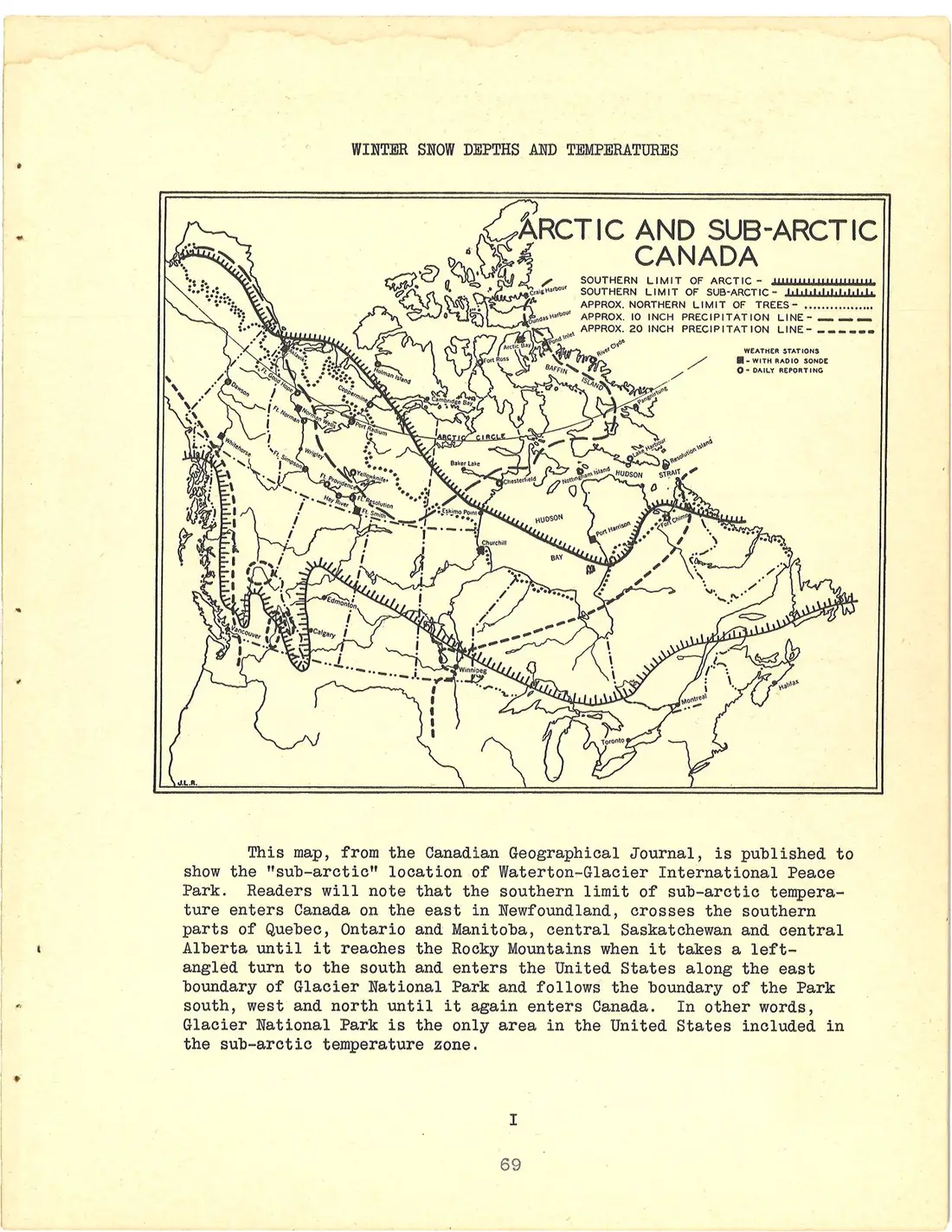
(Map: "Arctic and Sub-Arctic Canada," showing the southern limit of arctic, southern limit of sub-arctic, approximate northern limit of trees, approximate 10 inch precipitation line, approximate 20 inch precipitation line, and weather stations.)
This map, from the Canadian Geographical Journal, is published to show the "sub-arctic" location of Waterton-Glacier International Peace Park. Readers will note that the southern limit of sub-arctic temperature enters Canada on the east in Newfoundland, crosses the southern parts of Quebec, Ontario and Manitoba, central Saskatchewan and central Alberta until it reaches the Rocky Mountains when it takes a left-angled turn to the south and enters the United States along the east boundary of Glacier National Park and follows the boundary of the Park south, west and north until it again enters Canada. In other words, Glacier National Park is the only area in the United States included in the sub-arctic temperature zone.
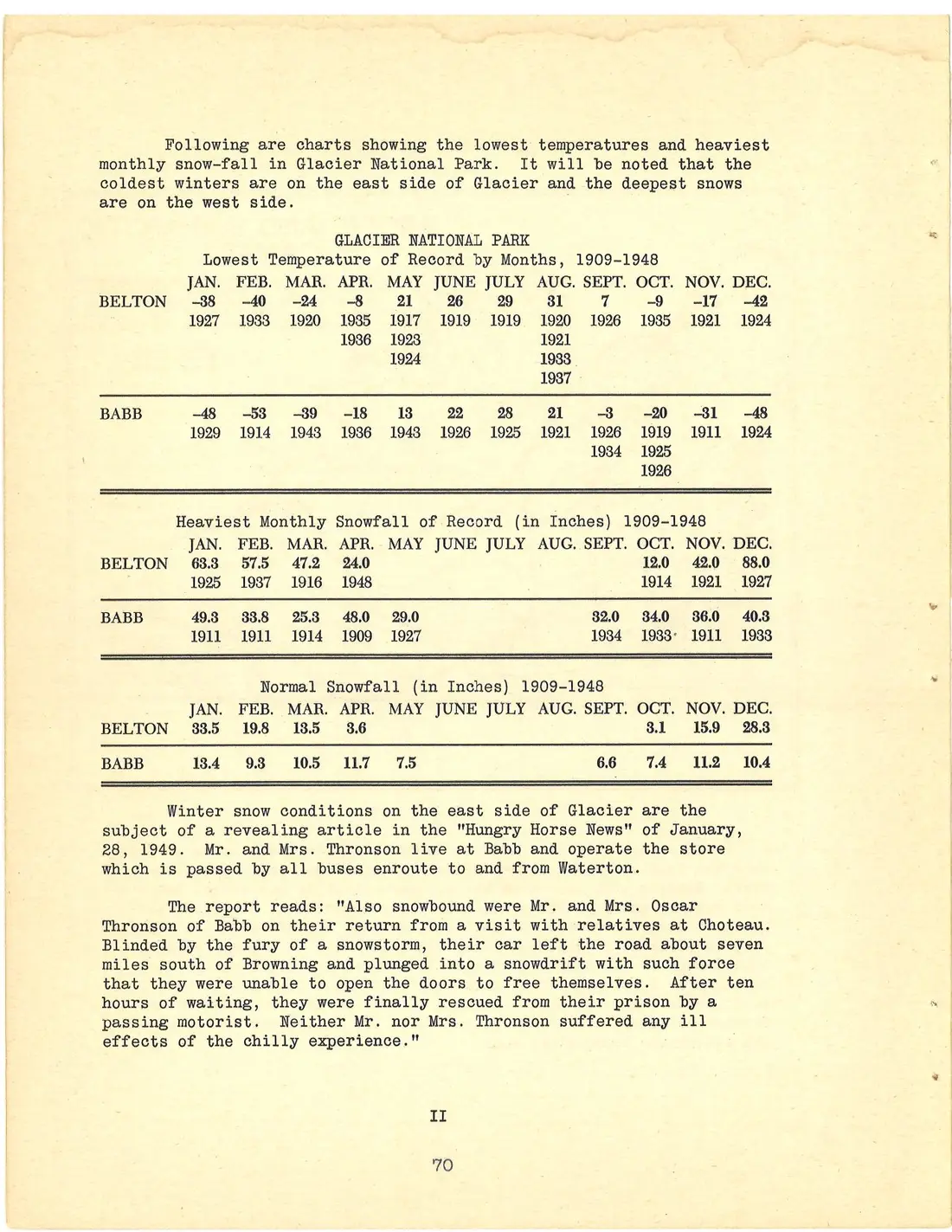
Following are charts showing the lowest temperatures and heaviest monthly snow-fall in Glacier National Park. It will be noted that the coldest winters are on the east side of Glacier and the deepest snows are on the west side.
GLACIER NATIONAL PARK
Lowest Temperature of Record by Months, 1909-1948
BELTON -- JAN. -38 (1927) -- FEB. -40 (1933) -- MAR. -24 (1920) -- APR. -8 (1935, 1936) -- MAY 21 (1917, 1923, 1924) -- JUNE 26 (1919) -- JULY 29 (1919) -- AUG. 31 (1920, 1921, 1933, 1937) -- SEPT. 7 (1926) -- OCT. -9 (1935) -- NOV. -17 (1921) -- DEC. -42 (1924)
BABB -- JAN. -48 (1929) -- FEB. -53 (1914) -- MAR. -39 (1943) -- APR. -18 (1936) -- MAY 13 (1943) -- JUNE 22 (1926) -- JULY 28 (1925) -- AUG. 21 (1921) -- SEPT. -3 (1926, 1934) -- OCT. -20 (1919, 1925, 1926) -- NOV. -31 (1911) -- DEC. -48 (1924)
Heaviest Monthly Snowfall of Record (in Inches) 1909-1948
BELTON -- JAN. 63.3 (1925) -- FEB. 57.5 (1937) -- MAR. 47.2 (1916) -- APR. 24.0 (1948) -- OCT. 12.0 (1914) -- NOV. 42.0 (1921) -- DEC. 88.0 (1927)
BABB -- JAN. 49.3 (1911) -- FEB. 33.8 (1911) -- MAR. 25.3 (1914) -- APR. 48.0 (1909) -- MAY 29.0 (1927) -- SEPT. 32.0 (1934) -- OCT. 34.0 (1933) -- NOV. 36.0 (1911) -- DEC. 40.3 (1933)
Normal Snowfall (in Inches) 1909-1948
BELTON -- JAN. 33.5 -- FEB. 19.8 -- MAR. 13.5 -- APR. 3.6 -- OCT. 3.1 -- NOV. 15.9 -- DEC. 28.3
BABB -- JAN. 13.4 -- FEB. 9.3 -- MAR. 10.5 -- APR. 11.7 -- MAY 7.5 -- SEPT. 6.6 -- OCT. 7.4 -- NOV. 11.2 -- DEC. 10.4
Winter snow conditions on the east side of Glacier are the subject of a revealing article in the "Hungry Horse News" of January, 28, 1949. Mr. and Mrs. Thronson live at Babb and operate the store which is passed by all buses enroute to and from Waterton.
The report reads: "Also snowbound were Mr. and Mrs. Oscar Thronson of Babb on their return from a visit with relatives at Choteau. Blinded by the fury of a snowstorm, their car left the road about seven miles south of Browning and plunged into a snowdrift with such force that they were unable to open the doors to free themselves. After ten hours of waiting, they were finally rescued from their prison by a passing motorist. Neither Mr. nor Mrs. Thronson suffered any ill effects of the chilly experience."
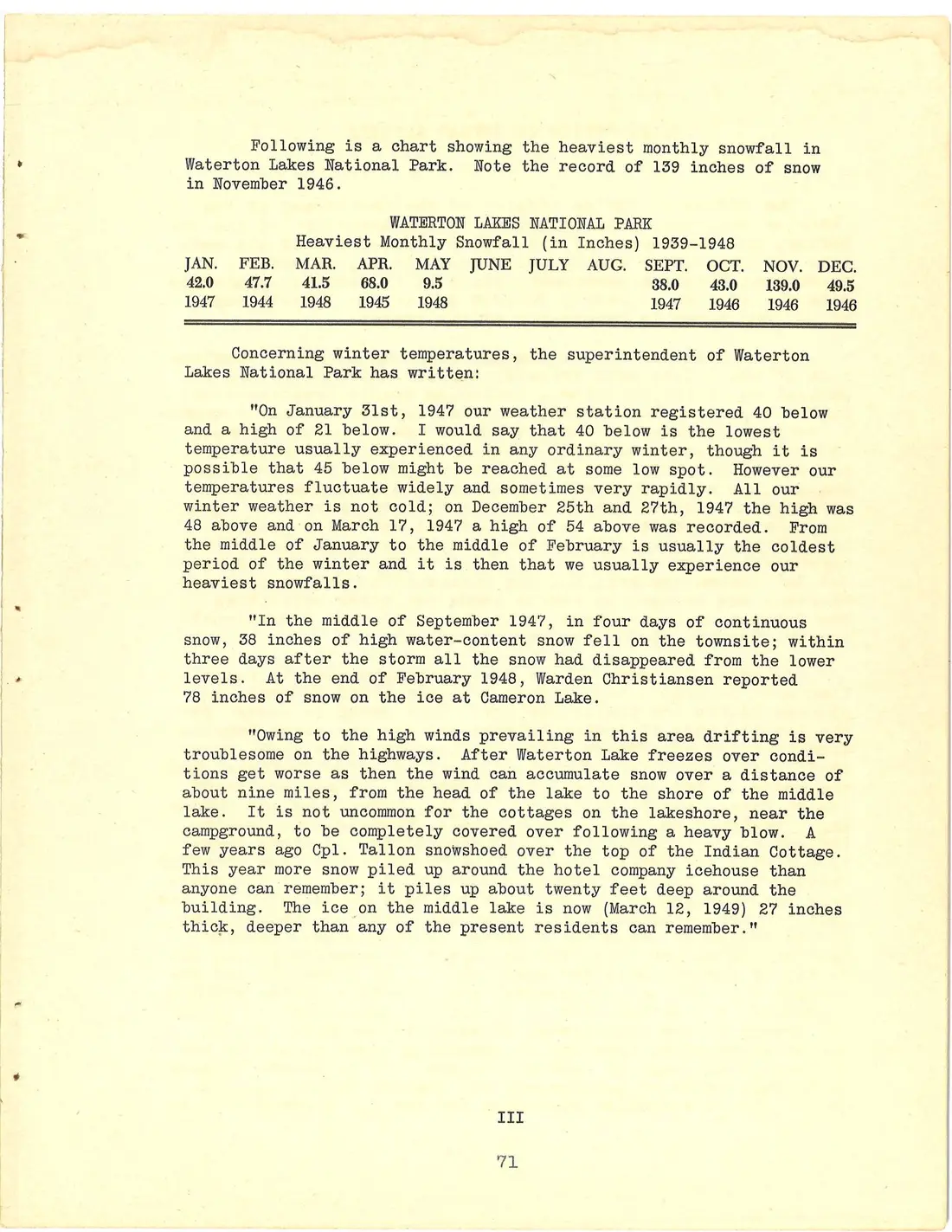
Following is a chart showing the heaviest monthly snowfall in Waterton Lakes National Park. Note the record of 139 inches of snow in November 1946.
WATERTON LAKES NATIONAL PARK
Heaviest Monthly Snowfall (in Inches) 1939-1948
JAN. 42.0 (1947) -- FEB. 47.7 (1944) -- MAR. 41.5 (1948) -- APR. 68.0 (1945) -- MAY 9.5 (1948) -- SEPT. 38.0 (1947) -- OCT. 43.0 (1946) -- NOV. 139.0 (1946) -- DEC. 49.5 (1946)
Concerning winter temperatures, the superintendent of Waterton Lakes National Park has written:
"On January 31st, 1947 our weather station registered 40 below and a high of 21 below. I would say that 40 below is the lowest temperature usually experienced in any ordinary winter, though it is possible that 45 below might be reached at some low spot. However our temperatures fluctuate widely and sometimes very rapidly. All our winter weather is not cold; on December 25th and 27th, 1947 the high was 48 above and on March 17, 1947 a high of 54 above was recorded. From the middle of January to the middle of February is usually the coldest period of the winter and it is then that we usually experience our heaviest snowfalls.
"In the middle of September 1947, in four days of continuous snow, 38 inches of high water-content snow fell on the townsite; within three days after the storm all the snow had disappeared from the lower levels. At the end of February 1948, Warden Christiansen reported 78 inches of snow on the ice at Cameron Lake.
"Owing to the high winds prevailing in this area drifting is very troublesome on the highways. After Waterton Lake freezes over conditions get worse as then the wind can accumulate snow over a distance of about nine miles, from the head of the lake to the shore of the middle lake. It is not uncommon for the cottages on the lakeshore, near the campground, to be completely covered over following a heavy blow. A few years ago Cpl. Tallon snowshoed over the top of the Indian Cottage. This year more snow piled up around the hotel company icehouse than anyone can remember; it piles up about twenty feet deep around the building. The ice on the middle lake is now (March 12, 1949) 27 inches thick, deeper than any of the present residents can remember."