Kootenai Brown
"KOOTENAI" BROWN
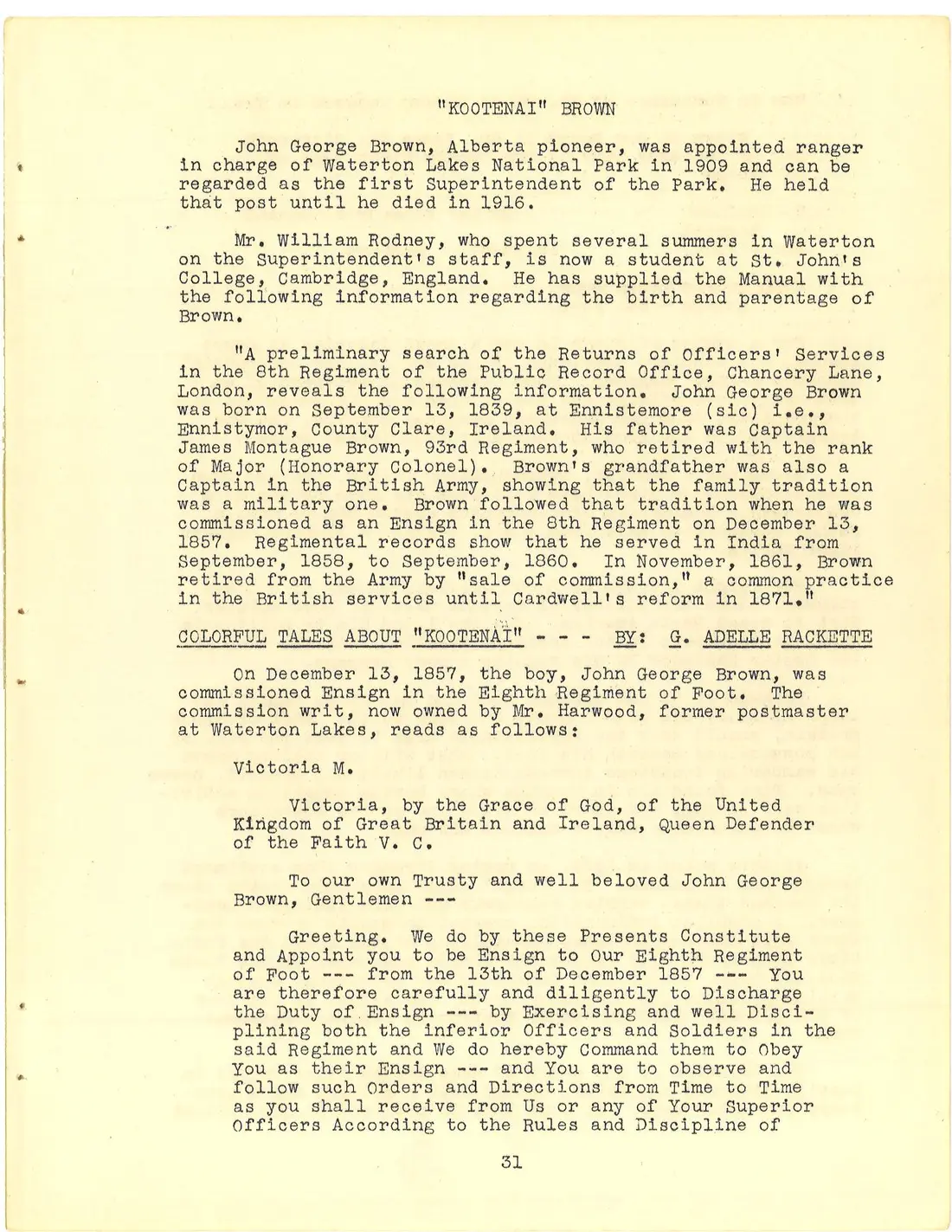
John George Brown, Alberta pioneer, was appointed ranger in charge of Waterton Lakes National Park in 1909 and can be regarded as the first Superintendent of the Park. He held that post until he died in 1916.
Mr. William Rodney, who spent several summers in Waterton on the Superintendent's staff, is now a student at St. John's College, Cambridge, England. He has supplied the Manual with the following information regarding the birth and parentage of Brown.
"A preliminary search of the Returns of Officers' Services in the 8th Regiment of the Public Record Office, Chancery Lane, London, reveals the following information. John George Brown was born on September 13, 1839, at Ennistemore (sic) i.e., Ennistymor, County Clare, Ireland. His father was Captain James Montague Brown, 93rd Regiment, who retired with the rank of Major (Honorary Colonel). Brown's grandfather was also a Captain in the British Army, showing that the family tradition was a military one. Brown followed that tradition when he was commissioned as an Ensign in the 8th Regiment on December 13, 1857. Regimental records show that he served in India from September, 1858, to September, 1860. In November, 1861, Brown retired from the Army by "sale of commission," a common practice in the British services until Cardwell's reform in 1871."
COLORFUL TALES ABOUT "KOOTENAI" - - - BY: G. ADELLE RACKETTE
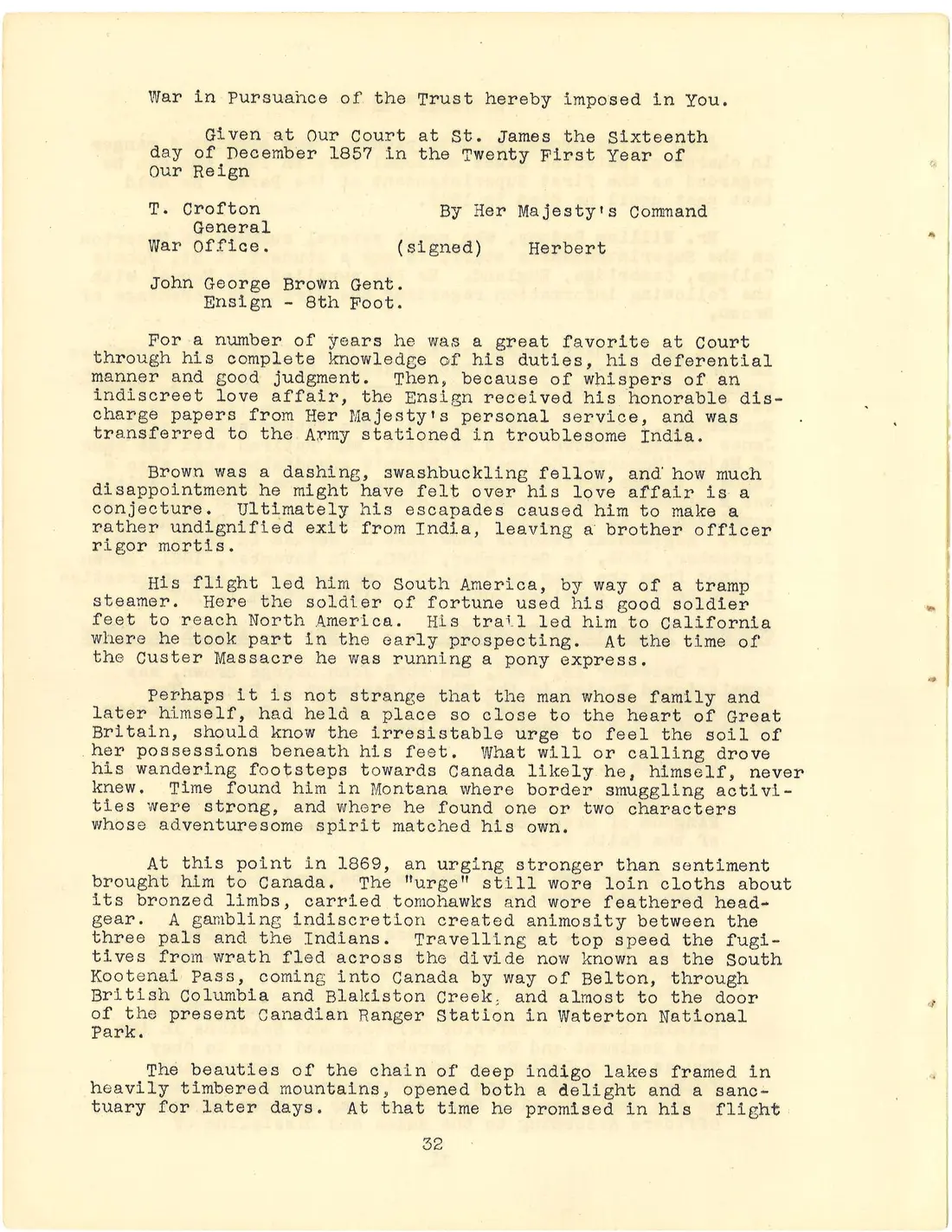
On December 13, 1857, the boy, John George Brown, was commissioned Ensign in the Eighth Regiment of Foot. The commission writ, now owned by Mr. Harwood, former postmaster at Waterton Lakes, reads as follows:
Victoria M.
Victoria, by the Grace of God, of the United Kingdom of Great Britain and Ireland, Queen Defender of the Faith V. C.
To our own Trusty and well beloved John George Brown, Gentlemen ---
Greeting. We do by these Presents Constitute and Appoint you to be Ensign to Our Eighth Regiment of Foot --- from the 13th of December 1857 --- You are therefore carefully and diligently to Discharge the Duty of Ensign --- by Exercising and well Disciplining both the inferior Officers and Soldiers in the said Regiment and We do hereby Command them to Obey You as their Ensign --- and You are to observe and follow such Orders and Directions from Time to Time as you shall receive from Us or any of Your Superior Officers According to the Rules and Discipline of War in Pursuance of the Trust hereby imposed in You.
Given at Our Court at St. James the Sixteenth day of December 1857 in the Twenty First Year of Our Reign
T. Crofton, General, War Office. By Her Majesty's Command (signed) Herbert
John George Brown Gent. Ensign - 8th Foot.
For a number of years he was a great favorite at Court through his complete knowledge of his duties, his deferential manner and good judgment. Then, because of whispers of an indiscreet love affair, the Ensign received his honorable discharge papers from Her Majesty's personal service, and was transferred to the Army stationed in troublesome India.
Brown was a dashing, swashbuckling fellow, and how much disappointment he might have felt over his love affair is a conjecture. Ultimately his escapades caused him to make a rather undignified exit from India, leaving a brother officer rigor mortis.
His flight led him to South America, by way of a tramp steamer. Here the soldier of fortune used his good soldier feet to reach North America. His trail led him to California where he took part in the early prospecting. At the time of the Custer Massacre he was running a pony express.
Perhaps it is not strange that the man whose family and later himself, had held a place so close to the heart of Great Britain, should know the irresistable urge to feel the soil of her possessions beneath his feet. What will or calling drove his wandering footsteps towards Canada likely he, himself, never knew. Time found him in Montana where border smuggling activities were strong, and where he found one or two characters whose adventuresome spirit matched his own.
At this point in 1869, an urging stronger than sentiment brought him to Canada. The "urge" still wore loin cloths about its bronzed limbs, carried tomohawks and wore feathered headgear. A gambling indiscretion created animosity between the three pals and the Indians. Travelling at top speed the fugitives from wrath fled across the divide now known as the South Kootenai Pass, coming into Canada by way of Belton, through British Columbia and Blakiston Creek, and almost to the door of the present Canadian Ranger Station in Waterton National Park.
The beauties of the chain of deep indigo lakes framed in heavily timbered mountains, opened both a delight and a sanctuary for later days. At that time he promised in his flight that he would one day return to make his home. He dared not stop, nor his friends, for angry Indians still pursued. The stillness of the prairies claimed him; the Riel Rebellion found him, and once again in 1885 he was in her Majesty's service as a scout.
With Mary Delano, his French half-breed wife, he returned to the mountains and settled on the spot that is now the Y.M.C.A. Camp Invspi, where he and his partner, one Fred Kanouse, ran the trading post for the I. G. Baker Company.
Wandering bands of Indians came across the border to barter with them, and many and varied were the experiences that Kootenai had with these nomads of the West. Nor did his wild escapade of several years before change his love of a practical joke at the game of chance.
On one occasion the Indians came to trade their furs for tea, sugar and the bright gew-gaws of apparel so dear to the Indian's heart. Kootenai and his partner, ever hospitable hosts, gave the traders liberal portions of whiskey, and then entertained them with horse races. The gambling instinct of the swarthy Indians ran rampant, they wagered until Brown and Kanouse had won back all they had given in trade.
When the Indians realized they had been victims of a great hoax, they conferred around a blazing camp-fire. Brown and Kanouse knew what that meant and firmly barricaded themselves in a log shack before the Indians started shooting at them through every possible opening. The miracle is that they did not resort to the savage instincts of scarcely a score of years previous and burn their victims in the cabin. Eventually they left, and Kootenai, who was unhurt, was obliged to travel with his partner in a buckboard over one hundred miles of wagon trail to Fort Macleod, in order that the latter's wounded arm might receive attention. Kanouse was never able to use the arm again.
Mary Delano Brown died about this time, after giving birth to two sons, both of whom died in early childhood.
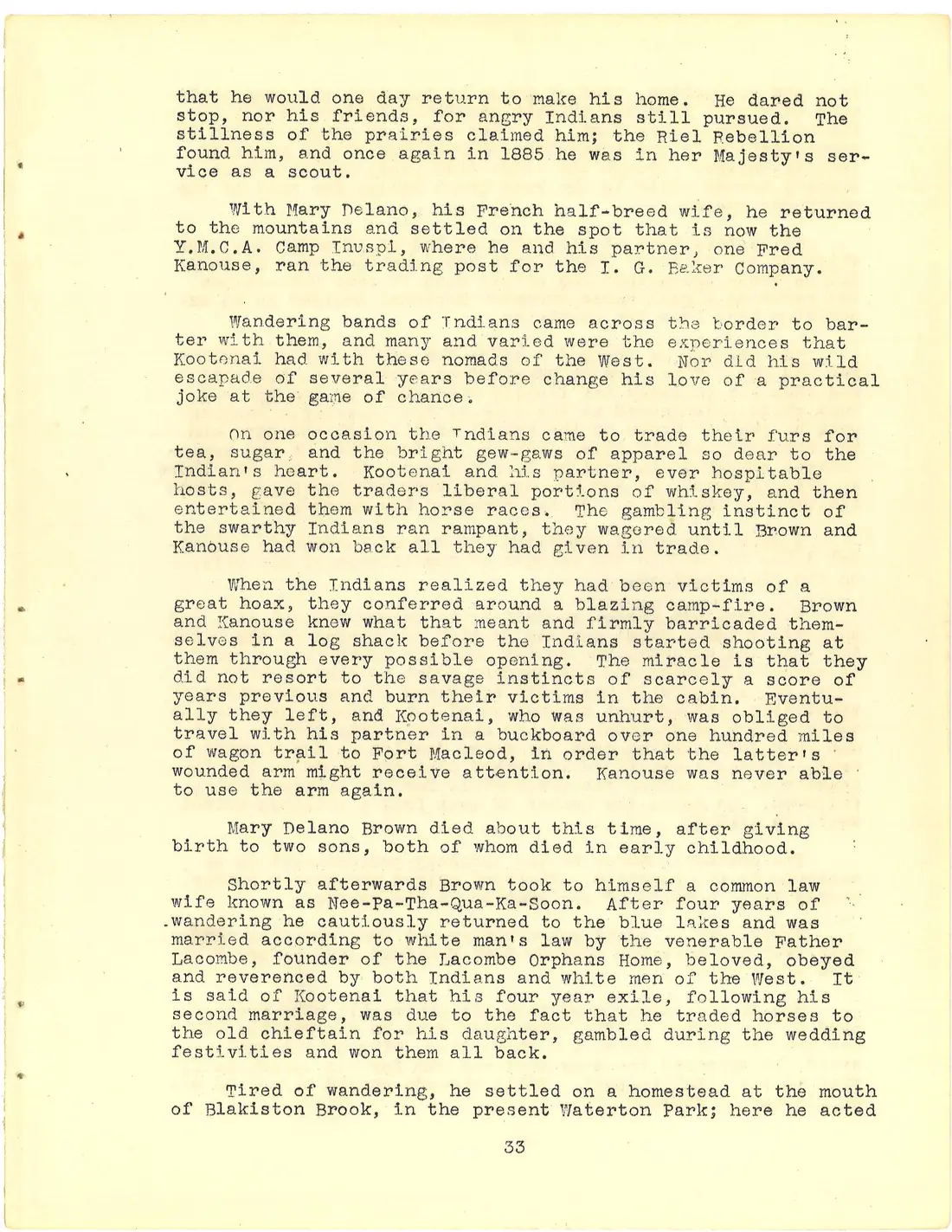
Shortly afterwards Brown took to himself a common law wife known as Nee-Pa-Tha-Qua-Ka-Soon. After four years of wandering he cautiously returned to the blue lakes and was married according to white man's law by the venerable Father Lacombe, founder of the Lacombe Orphans Home, beloved, obeyed and reverenced by both Indians and white men of the West. It is said of Kootenai that his four year exile, following his second marriage, was due to the fact that he traded horses to the old chieftain for his daughter, gambled during the wedding festivities and won them all back.
Tired of wandering, he settled on a homestead at the mouth of Blakiston Brook, in the present Waterton Park; here he acted in a new occupation, that of guide to tourists who were beginning to travel from the thickly populated eastern cities to the mountains of the West. He also acted as packer to the advance parties in the surveying and building of the Canadian Pacific Railway through the Crows Nest Pass; and with less dignity herded bulls in the Pass Creek Valley for many of the early day ranchers.
It is told that at his cabin he had an immense tame bear which he had released from a trap and domesticated. So well did he train bruin that the animal used to come when called and serve as a pack horse whenever Kootenai decided on an expedition back into the mountains.
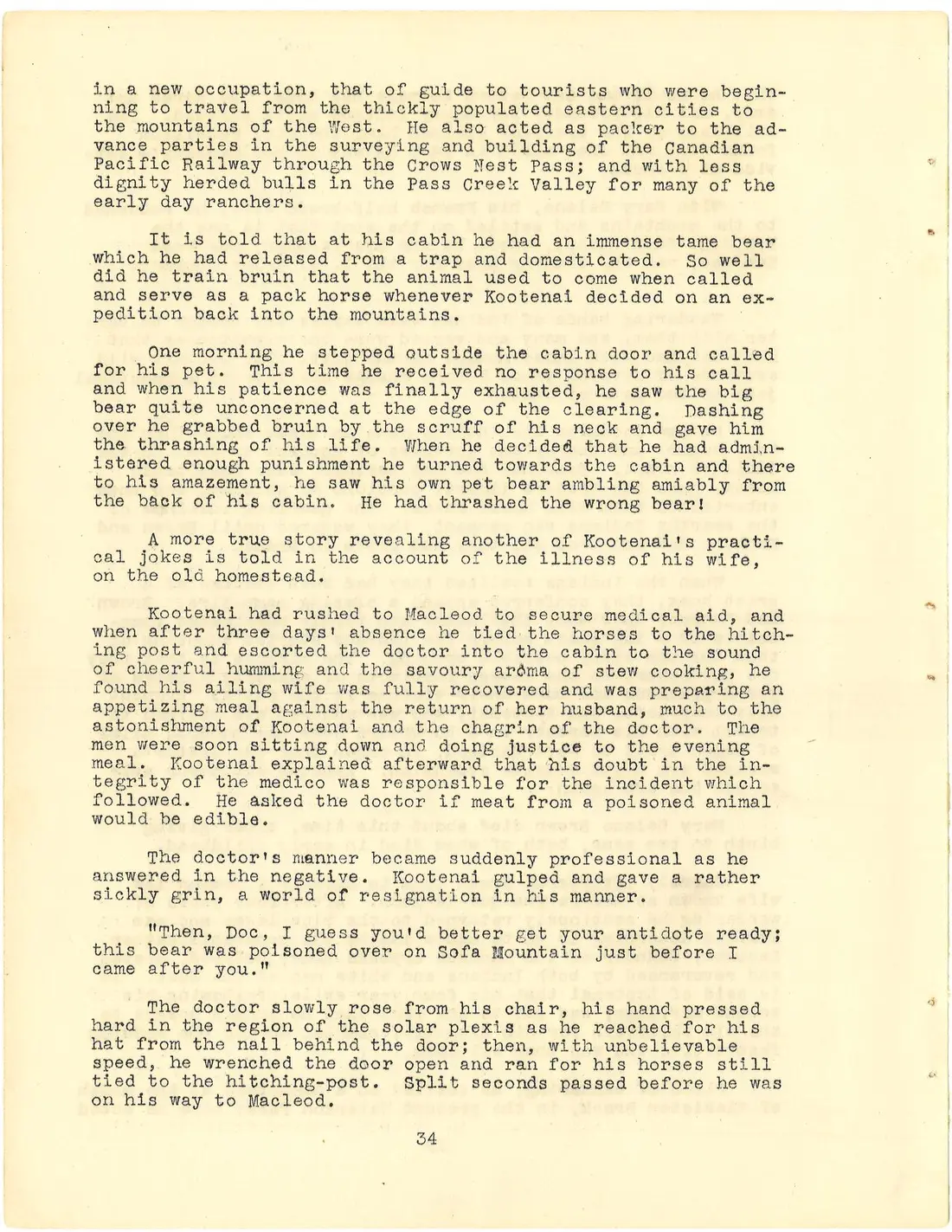
One morning he stepped outside the cabin door and called for his pet. This time he received no response to his call and when his patience was finally exhausted, he saw the big bear quite unconcerned at the edge of the clearing. Dashing over he grabbed bruin by the scruff of his neck and gave him the thrashing of his life. When he decided that he had administered enough punishment he turned towards the cabin and there to his amazement, he saw his own pet bear ambling amiably from the back of his cabin. He had thrashed the wrong bear!
A more true story revealing another of Kootenai's practical jokes is told in the account of the illness of his wife, on the old homestead.
Kootenai had rushed to Macleod to secure medical aid, and when after three days' absence he tied the horses to the hitching post and escorted the doctor into the cabin to the sound of cheerful humming and the savoury aroma of stew cooking, he found his ailing wife was fully recovered and was preparing an appetizing meal against the return of her husband, much to the astonishment of Kootenai and the chagrin of the doctor. The men were soon sitting down and doing justice to the evening meal. Kootenai explained afterward that his doubt in the integrity of the medico was responsible for the incident which followed. He asked the doctor if meat from a poisoned animal would be edible.
The doctor's manner became suddenly professional as he answered in the negative. Kootenai gulped and gave a rather sickly grin, a world of resignation in his manner.
"Then, Doc, I guess you'd better get your antidote ready; this bear was poisoned over on Sofa Mountain just before I came after you."
The doctor slowly rose from his chair, his hand pressed hard in the region of the solar plexis as he reached for his hat from the nail behind the door; then, with unbelievable speed, he wrenched the door open and ran for his horses still tied to the hitching-post. Split seconds passed before he was on his way to Macleod.
After he had gone, Kootenai and his wife held their sides as they gave way to uncontrolled laughter.
The truth of the matter was that Kootenai himself had poisoned the bear and he believed that since he had removed the entrails before the poison had reached the blood stream, the meat was perfectly wholesome.
Practical joking was not the only accomplishment along the lines of entertainment that were attributed to John George Brown. One incident is reported during a hunting trip to the mountains with Lord Latham. Brown was past master in the art of cursing and on this particular occasion the cowboys were busy preparing the horses for the trip. The cowboys were busy breaking camp one morning, and Kootenai was helping with the pack saddles, when he adjusted the latigo strap with such vigor that it broke with a resounding snap, and deposited him back against a stone with such an impact as to render him speechless--but not for long. Then ensued the most illuminating flow of language that his Lordship had ever heard. He looked first bewildered, then comprehendingly, and finally admiringly at Brown and then exclaimed: "My good fellow - would you - mind repeating that?"
John George (Kootenai) Brown was a very handsome man in his youth, standing 6 ft. 2 in. in height, but during his life of adventure his legs had been broken so many times that his stature took on a height of 5 ft. 8 in. Strangely enough both legs swayed in the same direction, which gave him a feeble appearance entirely belying the energy of his body.
There is an old saying that if one would learn a man's background one should see him intoxicated. Such is the test of manhood, and to such Kootenai Brown measured up. No matter what the in-between years had been, his birthright and culture as a young man were genuine. Let no man scoff because he was a squaw-man; his Indian wives received the courtesy and consideration due the wife of a white man, and the man who, drunk or sober, uttered a disparaging remark about either Mary Delano Brown or "Nee-Pa-Tha-Qua-Ka-Soon" had to deal with the indignant wrath of Kootenai.
To his love for beauty and sanctuary and the inherent love of England are credited the endless stream of correspondence, and finally his trip to Ottawa that caused the setting aside of Waterton Lakes as a national park. He was its first superintendent, with the title of "Forest Ranger".
Brown died in 1916 and, twenty years later when the Chief Mountain Highway was built, the surveyors hewed the road through the trees past the corner fence of his old homestead, almost at the top of the "steppes", or last long stretch of road leading down to the Waterton Bridge in Waterton Lakes National Park.
In 1936, a few of his old friends donated funds to build a cairn in honor of his memory, in the village of Waterton Park. This was built by his lifelong friend Arthur H. Harwood, Postmaster and Magistrate of the park. Mr. Harwood hand-picked all the rock that went into the cairn. This was unveiled at a very impressive ceremony in mid-summer when the Lieutenant General of Alberta was in attendance.
In the proud possession of Magistrate Harwood are the aged parchment appointment paper of John George Brown, Gentleman, as ensign in Her Majesty's 8th Regiment of Foot, and his medals as scout in the Riel Rebellion.
Kootenai Brown was buried in the little picket fenced plot near the lower Waterton Lakes, with his Indian wives on either side of him; it is also said that a good bottle of contraband whiskey rests more closely to him, the last joke of his friends on him who so loved a practical joke.
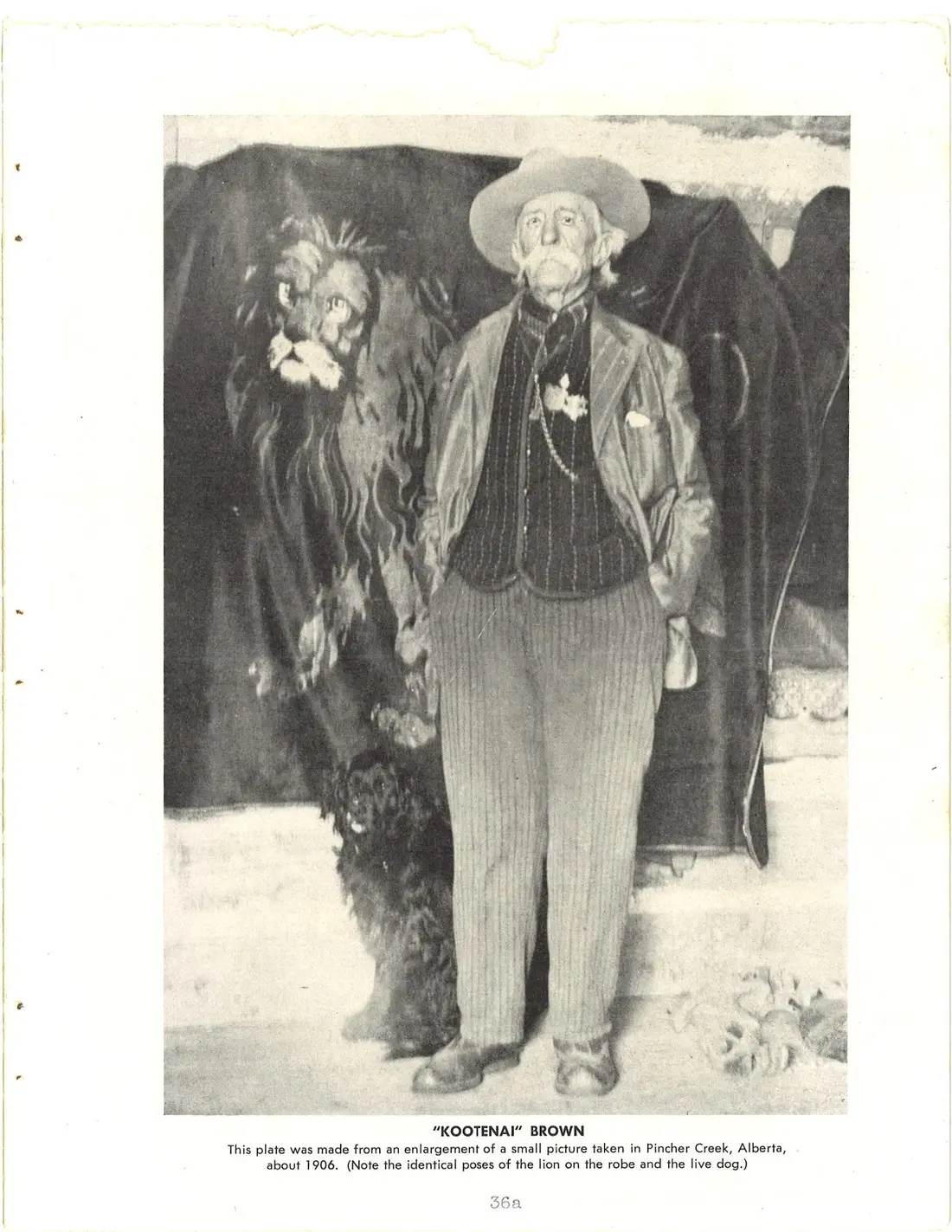
[Photograph: "KOOTENAI" BROWN. This plate was made from an enlargement of a small picture taken in Pincher Creek, Alberta, about 1906. (Note the identical poses of the lion on the robe and the live dog.)]