The Glacier Park Transport Company
THE GLACIER PARK TRANSPORT COMPANY
Howard H. Hays
When Glacier National Park was established in 1910 the area was a wilderness. There were no roads inside the present park limits and there was no highway in the Blackfeet Reservation running north and south such as the present Blackfeet Highway. The Great Northern Railroad built the first wagon roads north from Glacier Park Station into Two Medicine Valley, Cutbank Valley, St. Mary Valley and Swiftcurrent Valley.
The first passenger transportation was by means of four-horse coaches of eleven passenger capacity. The outfit was owned by the Brewster brothers of Canada. Horse-drawn service was discontinued in 1914.
In 1914, Roe Emery, a native of Montana, who was a resident of St. Paul, Minnesota, formed the Glacier Park Transportation Company and instituted a system of automobile transportation. The buses were specially designed and manufactured by the White Motor Company of Cleveland, Ohio. This was the first authorized motor transportation utility in any national park. (Yellowstone was not motorized until 1918.)
Mr. A. K. Holmes, now General Manager of the Rocky Mountain Motor Company of Denver, Colorado, was the first manager of Mr. Emery's Glacier bus line. He served from 1914 to 1919.
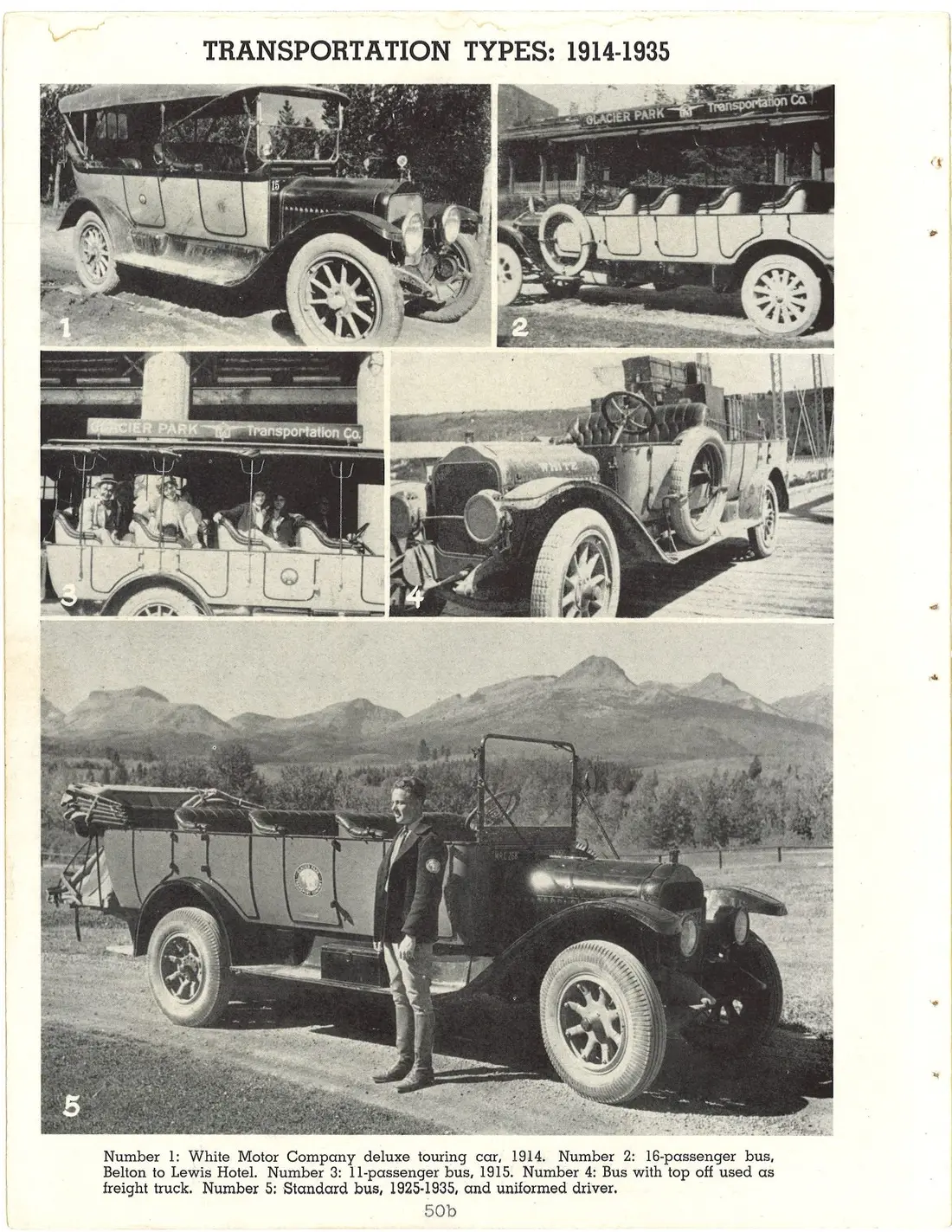
The first Glacier buses were of twelve passenger capacity, including the driver, four seats each of three passenger width. The original bodies had stationary tops and the back end of the body was an end-gate that dropped down to carry baggage. Baggage was also stored under the seats which were removable.
In a letter to the writer, Mr. Holmes recalled the 1914-1915 summers in Glacier:
"In June, 1914, as I remember it, we unloaded ten 11-passenger buses, five 7-passenger touring cars, and two 2-ton trucks on the platform at Glacier Park Station. I was there to superintend the unloading. For your information, there were no garage buildings of any kind. We parked this equipment under the trees and used packing cases for our parts room. Oil and gasoline were kept in barrels on skids where we could fill buses and trucks. As I remember, this spot was near the old Brewster Stables. It wasn't until late in 1914 that the Great Northern built the present garage (Number 1).
"These buses did not have canvas tops. They were stationary wood tops supported by iron braces, with side curtains. The top did not roll back. Across the length of the bus were two wooden signs on brackets - 'Glacier Park Transportation Company'. These signs would break off on one round trip; consequently, they were eliminated.
"The year 1914 was a dry one and the company did considerable road building; mainly to take the dips out, so that the baggage racks would not hit the ground and tear off when going into the dips. These dips were filled in and made so that we could use the longer buses.
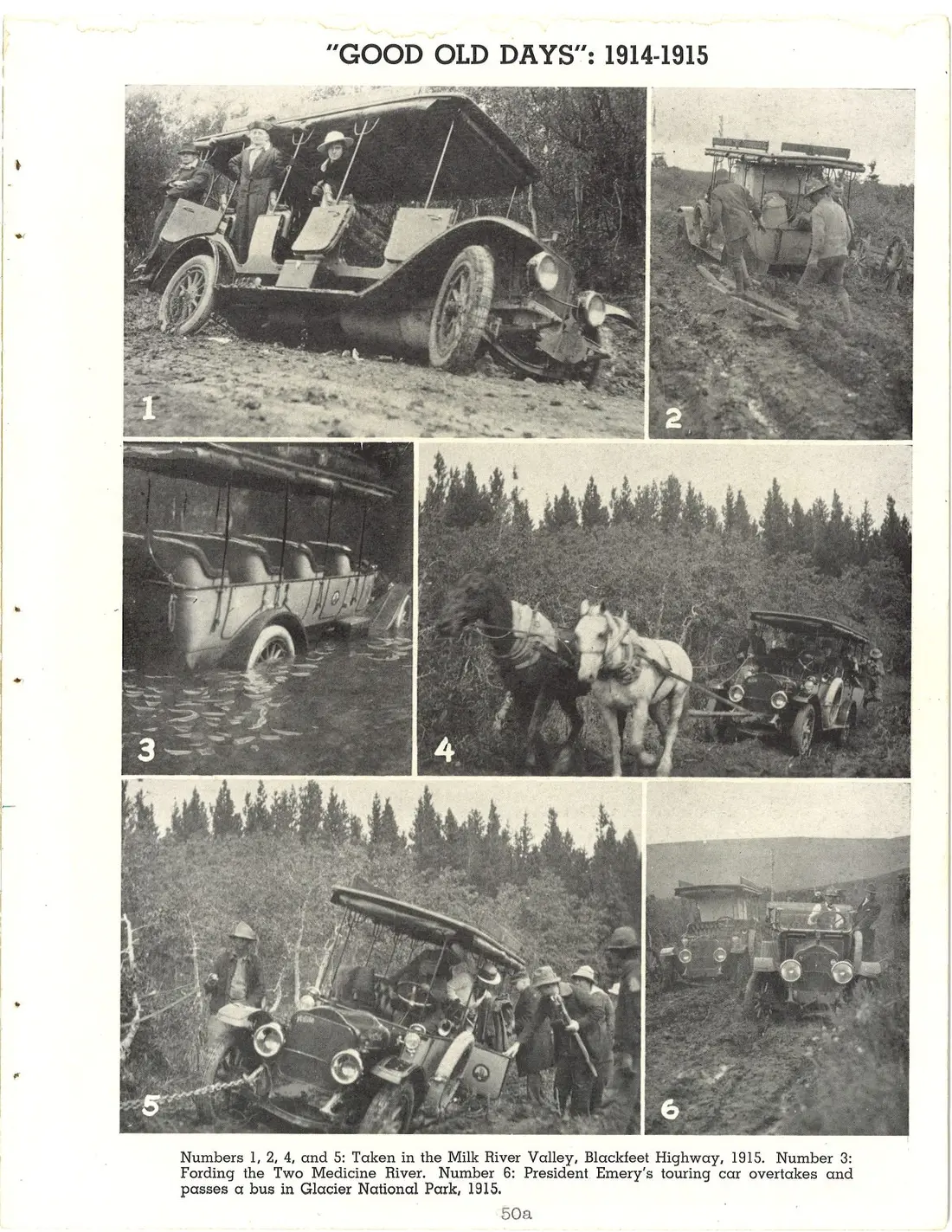
"1915 was rainy. It rained almost every day that season. Roads in general were very bad. The Milk River flats became a sea of mud. Jack Galbreath, who was formerly a teamster, had an 8-horse team. He camped at Milk River flats. We would run the buses as far as we could get them; then Jack would hook on with his 8-horse team, sit on the fender, and drive the horses with the help of the power of the bus, to get thru the mud holes. We endeavored to corduroy this, but they seemed to sink out of sight.
"After all is said and done, in looking back it was a pretty rugged type of transportation. One of the things I remember best is that during that terribly rainy summer, Mr. Emery would say every night, "We are quitting tonight - no more buses". The next morning, when the sun would shine for a while, he would say, "Well, I guess we will try it again". This was repeated every day during the rainy season."
It would be impossible to give a modern visitor or bus driver a clear idea of the transportation difficulties in those early days. The roads were little more than trails, often dug-ways, along the sides of the hills with no foundations and little or no drainage. The bridges were crude wooden structures with poles for planking. In the low stretches in the Cutbank Valley and the Milk River Valley the road base was gumbo soil. During the frequent summer rainstorms when this soil was saturated with water it became impervious and soapy to such an extent that the bus tires would not stay on the road. Moreover, the wheels with their chains would sink down in the roadbed to the axles. As Mr. Holmes states, it was frequently necessary to engage horses to pull the buses out of the ruts. Many dramatic incidents occurred during this period. The resourcefulness of Mr. Emery and his associates and the skill of the drivers were often taxed to the utmost in order to provide service during storm periods.
In the year 1916 Mr. Emery established transportation in Rocky Mountain National Park in Colorado and also embarked in the transportation business in the city of Denver. In 1927 the Glacier Park Transportation Company sold its properties to a new corporation, The Glacier Park Transport Company, which is the present operator in Glacier National Park. This company was organized in 1927 by Howard H. Hays.
[Photograph: "GOOD OLD DAYS": 1914-1915. Numbers 1, 2, 4, and 5: Taken in the Milk River Valley, Blackfeet Highway, 1915. Number 3: Fording the Two Medicine River. Number 6: President Emery's touring car overtakes and passes a bus in Glacier National Park, 1915.]
[Photograph: TRANSPORTATION TYPES: 1914-1935. Number 1: White Motor Company deluxe touring car, 1914. Number 2: 16-passenger bus, Belton to Lewis Hotel. Number 3: 11-passenger bus, 1915. Number 4: Bus with top off used as freight truck. Number 5: Standard bus, 1925-1935, and uniformed driver.]
Mr. Hays had first engaged in the tourist business in 1905 in Yellowstone National Park. He was for many years general passenger agent for the Wylie Company in Yellowstone. Later, he consolidated this company with other camping companies and transportation companies and became the president of the Yellowstone Camps Company in 1919. In 1924, owing to ill health, he sold his Yellowstone interests and moved to Riverside, California. In 1926 he organized the Sequoia and Kings Canyon National Park in the State of California. Mr. Hays is president of this company as well as the Glacier Park Transport Company.
In 1923, the pioneer bus bodies were replaced by bodies with folding type tops (see illustration). The baggage boot, at the rear, was built on an extension of the frame. A square of canvas was strapped over the baggage. By 1930, the fleet of buses numbered 66. In those years, the number of drivers, including touring cars and freight trucks, often exceeded 70. (It must be understood that the present fleet of 15-18 passenger capacity buses will transport as many passengers on a "peak" day as the 66 buses of 1930.)
In 1927, the Glacier Park Transport Company first entered the Dominion of Canada, in order to serve the newly constructed Prince of Wales Hotel in Waterton Lakes National Park, Alberta. The only available route at that time was by way of Cardston, Alberta. The summer of 1927 was a memorable one from the standpoint of operating difficulties. The road from Babb to Cardston was a gravel highway. From Cardston to Waterton, a distance of 35 miles, the road was a dirt highway, utterly unequal to bus transportation. During rainy weather it was often necessary to leave the highway and travel through the fields. At times it was necessary to engage farmers to pull the buses out of the ruts and mudholes. As a result of the operating difficulties of the summer of 1927, the Great Northern Railway made an agreement with the Province of Alberta to purchase $100,000 worth of its bonds, the proceeds of which were used to gravel the road between Cardston and Waterton Lakes National Park. The Transport Company gave service between the two parks by way of Cardston until the Chief Mountain International Highway was opened in 1935.
During the early years, Going-to-the-Sun Camp was a favorite spot for visitors. It was reached only by boat service from St. Mary's Camp at the foot of St. Mary's Lake. The Going-to-the-Sun Highway or Logan Pass Highway was constructed over a period of many years. The road was first completed from Belton to Logan Pass on the west side of Glacier Park. During these early years there was no highway along the south boundary of Glacier National Park between Glacier Park Station and Belton. The Transport Company operated a few buses on the west side of the park to give service between Belton and Lake McDonald Hotel which was then owned and operated by John Lewis. It was necessary to ship the buses by rail between Glacier Park Station and Belton because there was no highway across the Rockies in Northern Montana. On several occasions when the Transport Company was providing transportation for large organized parties, the passengers would first arrive at Glacier Park Station and make the tour on the east side of the Park, then the passengers would be loaded into sleeping cars and the buses would be loaded on flat cars for transportation to Belton, where the passengers would take the same buses, with the same drivers they had used on the east side of the park, for transportation to Lake McDonald Hotel. The Going-to-the-Sun Highway was completed in 1934. Highway No. 2 along the south boundary of Glacier National Park was not opened for through travel until 1930.
In the years 1936 to 1939 new buses were purchased to replace the old type bus. The present fleet consists of thirty-seven of these new models, which are of 15-18 passenger capacity. These buses were designed for a specific service--sightseeing in Glacier National Park. The greatest care and consideration in design was for the comfort and pleasure of the passenger. The chassis was built by the White Motor Company. Bodies were built by the Bender Body Company of Cleveland, but considerable contribution in body line design was by the industrial designer, Alexis deSaknoffsky. The present custom-built bus fits exactly the requirements of sightseeing in Glacier National Park. The Company sees no important factor of obsolescense because if additional buses are required, the present type will be ordered.
The change from the open touring car for special service to the sedans now in use reflects directly the traveler's demand for the maximum in motoring comfort. As roads improve travel at higher speeds in an open car becomes less comfortable. The first cars used in special service were White built touring cars. Then in 1927, eight specially designed touring cars on an extra long wheelbase chassis were purchased from the Cadillac Company. These cars were very successful in size and design. In 1939 began the replacement of these touring cars with the seven-passenger sedans. The two latest additions to this special car fleet were in 1947.
Fred A. Noble, General Manager, first entered the National Park traffic field in Rocky Mountain National Park in 1917. From 1917 to 1925 he was employed by the Rocky Mountain Parks Transportation Company. In 1923 he came to Glacier Park as Superintendent of the Glacier Park Transportation Company and in 1925 became General Manager succeeding Mr. George L. Moore who died while in the service of the company. Mr. Noble continued as General Manager when the company was reorganized in 1927. His employment has been continuous with the exception of the war years, 1943, 1944 and 1945, when no transportation service was performed due to wartime regulations. During the war years, 1942-45, Mr. Noble performed an outstanding war service for his country as Manager of the Office of Defense Transportation for the State of Montana, with headquarters at Butte. His administration of this important office was recognized, both in Washington and in Montana, as a service of the highest order.
Mr. Lyle C. McMullin was first employed by the Glacier Park Transport Company in the season of 1936; he was reemployed the following two seasons. In 1939 he became Office Manager after training in and preparation for bookkeeping and accounting at the College of Commerce, Bowling Green, Kentucky. He is responsible for the keeping of all records and the preparation for filing of all Company reports. His service with the Company has been continuous since 1939, except for the war years. He enlisted in the U.S. Navy in May, 1942 and served until January, 1946.